
Dave Newbitt
I’m sure many of you know all about this but I’m afraid I didn’t until I came across this online. Fascinating, not to say awe inspiring.
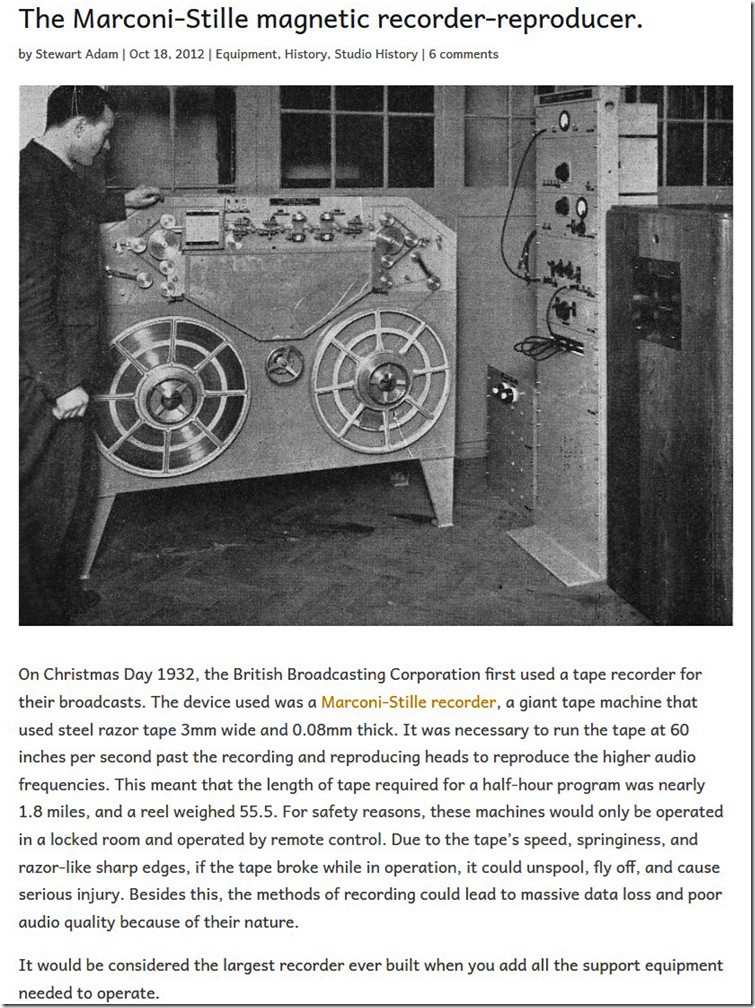
Graeme Wall
Was this the beast that a reel came off during recording and went straight through the wall of its compartment?
Allegedly you edited the tape with a soldering iron.
Mike Giles
I think joints were welded, rather than soldered!
Alan Taylor
There’s some bits of one exhibited at the Broadcast Engineering Museum. I know there’s a reel for the tape and a sample of the steel ribbon which it recorded upon. I can’t remember if they have anything of the machine itself, but there’s a good description of it and a photo which might be the same one in this thread. I’m pretty sure that in their library they have TIs explaining how to maintain the machines.
If there is more to show, I’ll take pictures next time I’m there.
The steel tape ( 3mm x 0.08 mm ) was manufactured in 1000m lengths. Each reel used three lengths, silver soldered together in order to be able to record for 30 minutes. They could be cut and edited. Joining was done by soldering or welding, but once there was about a dozen edits, the reel of tape was scrapped as the fast moving joints could damage the record and playback heads.
The tape passed the heads at 1.5 metres per second, which is about 60 IPS. A full reel weighs 25lbs. You wouldn’t want to be anywhere near it if the razor sharp tape broke while it was running.
Philip Tyler
The tape was ‘overlapped’ and a spot welder was used. All edits had an audible ’plop’ to them.
John Howell
Yes I was lucky enough to be given a PA job for the then DE Jimmy Redmond at the Royal Instition on the 50 Years of the BBC celebrationsI was tasked with getting an output from the Merconi-Stille into the PA system. A frighting machine, you needed welding gloves to handle the tape, I stayed we’ll away from those spools feeding the tape through at 60 inches per second!
The response was dead flat from 50 to 4,000 cps I can’t remember the noise figure but it was not good.
Alan Taylor
I think the noise figure was something like 35db and I’m pretty sure it used DC to erase the tape before it passed the record head.
Dave Plowman
I’m curious about the projected practical use of this device? Over a direct cut disk? If editing was such a performance?
Alan Taylor
I assumed that the main attraction was that material could be recorded, played later once or twice and then the tape could be reused indefinitely. There are lots of circumstances in broadcasting where a whole programme, or elements of a programme are re-broadcast several times within a day or over a few days, but will never be needed again.
Editing was possible, which wasn’t the case with disk cutting, but it was such a faff and reduced the longevity of the tapes that I wonder why people chose to do it?
This is a perfect example of how the hardware is documented, but there are very few details about how it was used operationally.
Hugh Snape
As I think I mentioned before there’s quite a bit of technical detail about these machines together with some descriptions of how they were used at Roger Beckwith’s site, here: