Alan Taylor
I was recently chatting to a TVC cameraman who recalled his attachment to OBs and covering golf. In particular he enjoyed following the ball from a tee shot.
I asked him about adjusting the peaking in the viewfinder, to make the ball more visible, but he also mentioned something I was previously unaware of. On LDK5s, you could select which tubes are shown in the viewfinder. By viewing, or deselecting certain tubes, you get to see improved contrast, which helps when following the ball. He couldn’t recall which tubes they were. Can any of you remember what the trick was?
Graeme Wall
I was told you just used the green tube, never operated an LDK5 so I can’t say whether that was accurate. The few occasions I did ball-follow on golf was using a mono v/f, as you say with the peaking tweaked up
Alasdair Lawrance
I would suggest not green, (grass) or blue (sky)….
Philip Tyler
Red Tube
Barry Wilkinson
I worked on a lot of golf as a cameraman using PC80 cameras ( LDK5?) . 99% of the time you would use the output in black and white of the green tube, which gave the best information to the eye. On a sunny day with no clouds it was relatively easy to follow the ball. On cloudy days you were reliant on the racks engineer exposing the camera to give maximum clarity as the ball reached the clouds . Some days it was extremely difficult for them to react quickly enough for the ball to be seen. The other difficulty was the trajectory of the ball being parabolic, so it rose very quickly after being hit and then slowed down rising but on the downward slope went more quickly. This trajectory altered depending on how steep the initial hit was, and then it was down to the cameraman’s experience in what to expect. On one very cloudy day I seem to recall that the ball was staying up in the sky too long until I realised a pigeon had crossed the path of the ball and I was following that. If you were on a scaffold tower which was quite high the problem then could be the mad golf followers climbing up it to get a better view of the course. This caused the tower to shake making any tight shots look unsteady. They also ignored the sign on the tower that said it was only designed for a maximum of two people and a heavy camera. It used to be very cold up the tower on coastal courses as the wind was stronger up there and not my favourite place to be most of the time!
Simon Morris
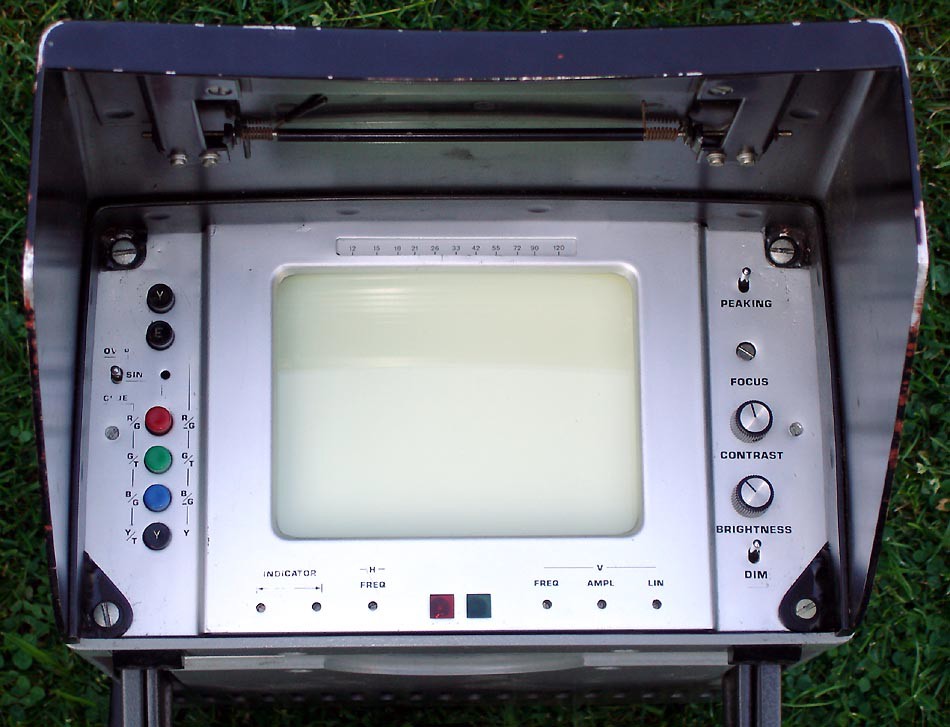
Found the attached image online. You can see the RGB switches on the left. As I remember it they were also used for line up as well as following golf balls. It might have been the blue tube we used. I think the viewfinder gave you a black and white view of the selected tube. So if the sky was blue it looked white and the ball black ( as the white ball was mainly red and green.) It was a long time ago so I might have that wrong!!
David Beer
My first OB when I transferred from TC to BBC Manchester in 1983 was a bit of a baptism of fire! The programme was Around with Alliss at Ganton golf course near Scarborough, where the golf commentator Peter Alliss shot a few holes and chatted with a celebrity. So I was instantly having to try and follow golf balls while positioned on a rather wobbly scissor hoist which is quite tricky if you’ve never done it before. In those days the viewfinders where only monochrome and you very much depended on your racks operator rapidly stopping the lens down when the ball went into the sky. I later learnt the trick of keeping the VF brightness low and also keeping a finger on the level knob to reduce it further when the ball hit the bright sky. I think I only missed a couple of shots. It was worse with the non-professionals as their shots were more erratic. What made the pressure worse was that the celebrity for that episode was Stuart Young who happened to be Chairman of the BBC board of Governors!