Alan Taylor
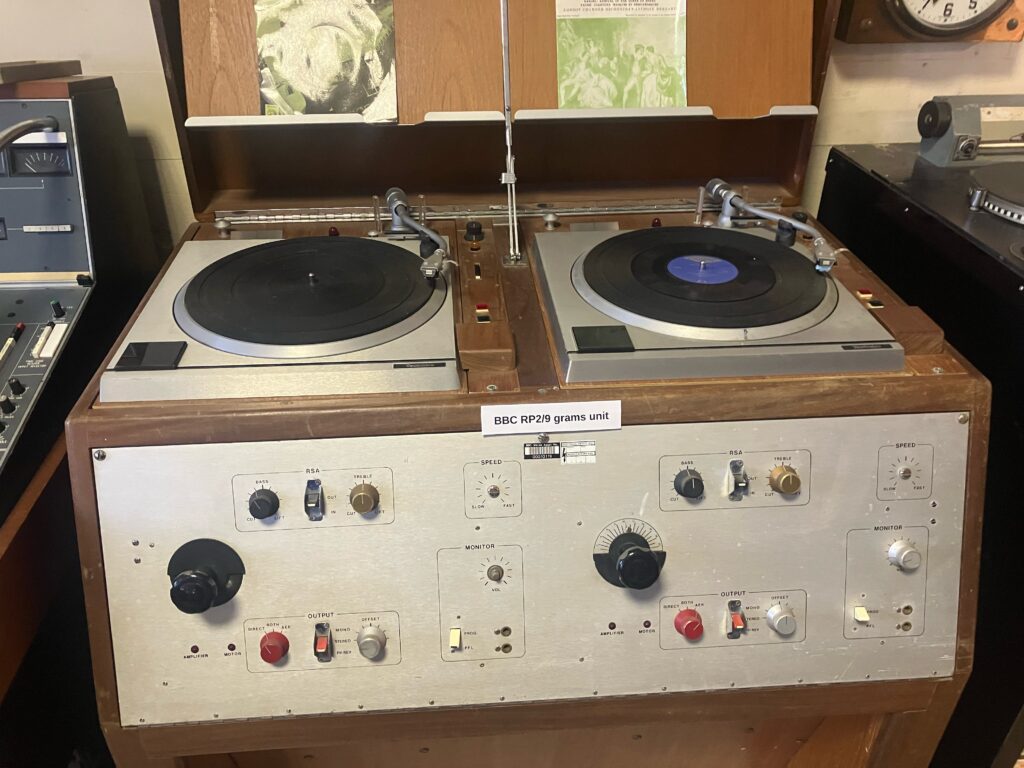
In the Broadcast Equipment Museum, they have this RP2/9 grams deck. Below and to the right of each fader knob is a red rotary switch. The three positions are engraved DIRECT / BOTH / AER.
I’ve never been a gram-op, but everything else seems obvious. However I’m puzzled by that one. Can anybody explain what AER relates to?
Mike Giles
I associate AER with radio studios and remember it as ”Acoustic Effects Reproduction”, which played the output onto a speaker in the studio so that the artists could hear it. Why it was a function of the disc player rather than the sound desk I’m unsure, but it amounts to what we would have called “Foldback” in TV studios.
Alan Taylor
That sounds entirely plausible and ties in with the ‘direct’ & ‘both’ positions of the switch, together with being grouped with the other Output controls.
It’s not an abbreviation I’ve come across before and the T.I.s they have for that type of grams deck don’t mention of that control, nor is it shown in the schematic diagrams.
I understand that the particular unit was originally installed in a radio studio in Cardiff.
Hugh Snape
AER was the BBC’s abbreviation for foldback. It stood for Acoustical Effects Reproduction and, as far as I remember, was a way of playing music or FX onto the studio floor via the foldback speaker.
Typically used in radio dramas this allowed the actors to hear the FX or music (the SLS was automatically muted when mics were faded up) and also permitted the material to be picked up by the mic(s) if desired.
As I recall the type A and B desks had a dedicated AER fader.
Direct, Both, and AER, on the gramdeck routed its output to the grams fader, the grams and AER faders, AER fader only.
All this seem pretty cumbersome today but desks then (at least the BBC designed ones) didn’t have the aux outputs we are familiar with today and so the above is how foldback was achieved.
David Plowman
Think the difference is FB is a ‘sniff’ of an FX etc fed into the prog chain direct – so an artist etc can just hear it. AER is only fed to the studio speaker and picked up via those mics. Useful if say adding an acoustic to the studio mics like say reverb as the effect will get that too. Etc.
Hugh Snape
Yes indeed, though on a modern desk you could achieve the same using a prefade aux.
NB, I think the AER keys on those RP2/9’s are really just a hangover from earlier grams. I never remember them being used at BH probably because, as I recall, RP2/9’s weren’t put in the type A or B Mk 2 studios. But might well be wrong !
John Howell
AER was primarily for putting a bit of ‘space’ around effects played from the gram desks. I remember struggling to make effects on disks more ‘distant’ by using this method. Back in the day you were presented with effects recorded close to a mic. just to get a decent recording level and it was up to you to treat it to make it sound distant, there was always the echo room !
As to why AER appeared on RP2/9s, this how P&ID worked, refurbishing a studio started with what was there already and added new facilities but often didn’t ask what was no longer required.
eg. The Prompt Cut and its bypass arrangements could have been missed off many TVC & LG studio refurbs going back at least 10 years, I think the only time I used it was as a ‘bleep’ inserter for a kids drama.
Hugh Snape
I remember being at a trade show after I’d left the BBC and seeing a brand new desk on the Calrec stand which was destined for TC. It had every sort of bell and whistle including a large stepped attenuator and other features which seemed rather archaic but which I suppose the Beeb was still happy to pay for . . .