Alec Bray
I was trying to find some useful pictures of the Vinten Motorised crane and suddenly came across this:
hifimuseum.de – Sie sind im Bereich : www.hifimuseum.de
Ein privates Audio – Hifi- und Tontechnik- Museum mit Anspruch auf Niveau. Audio- Historie und Technik – verbunden mit immensem Fachwissen verbunden mit Tonband- und Magnetbandmuseum sowie dem Deutschen Fernehmuseum.

please use Firefox, NOT Chrome …

I had never come across this site before.
The guy who runs it has got a whole lot of stuff from the German rep for Vintens, but none of it is yet on line. He seems to have got a whole lot more stuff than I was able to get in England!
Yes, it is a German site, but many browsers offer a translation option: Firefox offers this:
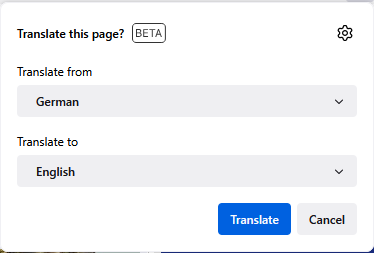
Alan Taylor says that on an iPad using Safari, in the URL address field there is an icon shaped like a rectangle with a long and a short bar beneath it. Clicking on that offers options for translation to any language – along with other options including summarising the content, speaking it out loud, or hiding annoying adverts.
Alan Taylor
That site resolved something which has puzzled me for about 55 years.
Somewhere around 1970, I was asked to repair a Grundig cassette player for somebody. The first thing I noticed was that the cassettes weren’t the same as Philips Compact Cassettes, they were similar but larger. The two types of cassette were incompatible.
I’ve never spoken to anybody who was aware of these cassettes and have previously mentioned them within this group, but there was no response. From time to time I’ve tried internet searches, but got no results.
However that site eventually came up with a passing reference, mentioning a name for that format.
It was then a simple matter to search for more information about the Grundig DC format and to discover that my memory has not been playing tricks on me. Well not this time anyway.
Grundig seem to have quite a history of losing format wars.
Geoff Fletcher
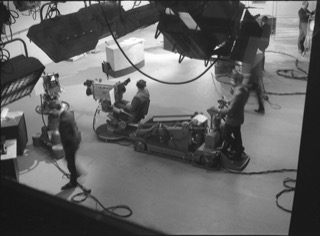
Here is a photo I took of a Vinten Motorised in use on a CETO program in TC5 on 16 March 1964. Crew 4 – Pete Ware up front with John Lower tracking. Mike Harrison on the left on the ped.
Might be of some interest to you.
Dave Buckley
Reading the recent emails about studio equipment, set me thinking as to where has all the now redundant peds, Heron, Moles etc gone?
Is there the equivalent of a used car lot for such gear somewhere?
Nick Ware
During the 1970’s I used to work on days off as a part time lecturer at Guildford School of Art, Film & TV Dept (with BBC approval). At some point the course moved to the newly-built Farnham Art School, and we moved into a fairly decent sized TV studio. Coinciding with that, I managed to acquire a Vinten motorised dolly that had been one of the ones we all knew and used at TVC. Why it was redundant I don’t know. It came to WSCAD f.o.c. provided that we had a 110VDC power supply for it. The studio tech and I found the necessary components and built a suitable PSU. Cameras were B&W Vidicons, similar to those we knew in Pres A & B.
So there was the Vinten, in all its splendour. Even the studio floor had been upgraded specially for it. But sadly, most of the students thought they were destined to be famous directors in the movie industry, and showed little or no interest in TV studio stuff. So the poor Vinten sat in a corner, hardly ever used.
In 1980 I left the BBC, and was suddenly earning real money, so lecturing for very little money became a thing of the past.
I don’t know what became of the Vinten Motorised after that. Probably gathered dust, if even used at all. So sad.
Paul Thackray
Quite a lot of ring peds found a new life as moving bases for jibs. The gas is removed and a fixed set up is used.
(Ring and Fulmar peds are too expensive to use now, because they need a yearly strip down and test.) The Quatro does not need testing as it is lower pressure.
More about the Mole Cranes
Alec Bray
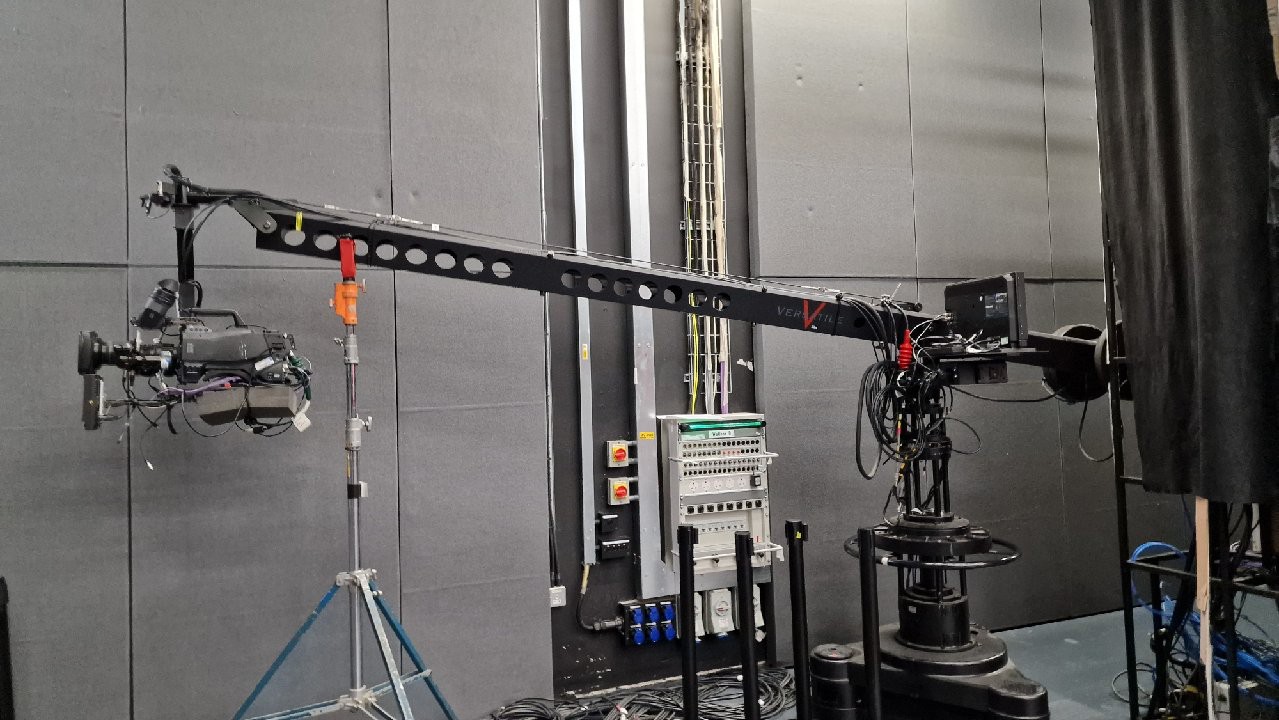
Searching the internet for some info about the Mole Crane, I came across this:
Well, I never knew that! Never did it in my time, but then the thing was so long that dropping the front may not have made that much difference!
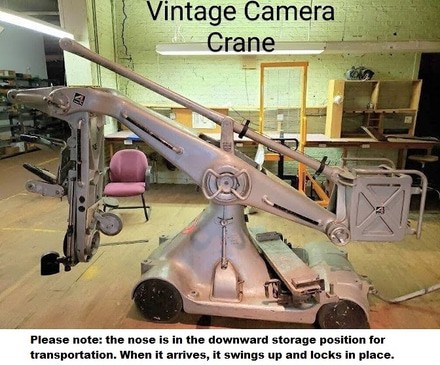
The picture is on a website – rjrprops.com – who offer old equipment as props, and it is identified as a Houston Fearless 30B camera crane. The caption reads:
“… This is an extremely rare vintage camera crane. It was also known as a “Mole Crane”. This same type of crane was used on Saturday Night Live for decades ”
So it was known as a “Mole Crane” in the States, too!!
Do any of you know any dimensions for the Mole Crane? (Such as the diameter of the wheels, or the wheelbase, or anything really!) . I have consulted Roger Bunce’s database, and the Edwards
Mounting Database, but there is little of any use for me there. I have contacted Mole-Richardson, but their reply was: The dimensions of the Mole-Richardson Motion Picture Research Council Crane manufactured in the late 1950s to early 1960s are no longer available ”
Sara Newman
Happy days with Roger Fenna on the front with Nigel Saunders / Adam Gordon swinging on Val Doonican in TV theatre It had an annoying surge as the forward gear engaged which you had to be careful of !! Oh happy days !
Graeme Wall
I have, somewhere, a hand out on the Mole Crane issued by the Guild, which gives dimensions. I’ll see if I can dig it out.
Steve Edwards
I have dimensions/drawings/weights etc I can forward from the original Mole Richardson manuals.
Twenty years ago I rescued a MPRC TV version Mole crane – (all 2 ton of it!!) You’ll recall this is the 3 man version and has the tracker’s platform extension at the rear – together with its 110V DC output Rectifier from Teddington Studios – formerly used by Thames Television. It is currently stored away in preservation.
Paul Thackray
Just in case you find one to operate, attached is the BBC Code of practice for Mole Operation.
Mole Crane Code of Practice
The Mole Crane is a three man operated counter-balanced crane with an all up weight of approximately two tonnes. It is also sometimes referred to as the M.P.R.C. (Motion Picture Research Council) Crane. It requires two power supplies, 110v DC for motive power, and 240v AC to power ancilliary equipment (talkback, monitors, etc.). Speed control for the motor is via a carbon pile rheostat, operated by control levers either side of the steering wheel. These ganged, spring-loaded controls can be operated in both forward and reverse directions, returning automatically to the central (neutral) position on release. A hydraulic foot brake is operated by a brake bar below the steering column.
There is a hydraulic safety lock on the jib operated by microswitches beneath a footplate on the camera platform and beneath the cameraman’s seat. Maximum height of the jib may be increased by means of a manually pumped hydraulic central column. There are friction brakes on the jib operated by handles either side of the centre point. These brakes will not hold the jib in an unbalanced state.
- General
Unauthorised Persons
No unauthorised persons, whether members of the public, artists, staff or contractors, are allowed onto, or to operate a camera crane. The only exception to this rule will be with the permission of the
Manager responsible for the Camera Section or his/her authorised representative.
The safe handling of camera cranes and other mountings comes within the responsibility for safety of all staff working to the Camera Supervisor. The Camera Supervisor or his/her nominated representative, is responsible for supervising all rigging operations. Regardless of production requirements, the safety of individuals is paramount and nothing should be undertaken wittingly which places this in jeopardy. The initial judgement of safety of operational situations lies with the cameramen and operators of the day. Their initial points of reference are the Camera Supervisor, Studio Resource Manager, and Floor Manager.
When operating camera equipment, the following order of priorities must be strictly adhered to:
PRIORITY 1: INJURY TO PEOPLE
At no time may any camera move be made which is likely to cause injury to people. All artists, members of staff, audiences and members of the public must be made fully aware via the Floor Manager or Production Manager, if necessary, of any safety requirements that a camera move may make of them.
PRIORITY 2: DAMAGE TO EQUIPMENT
Regardless of production requirements, no camera move may be made which is likely to cause damage to equipment.
PRIORITY 3: PRODUCTION REQUIREMENTS
Camera staff must be satisfied that the operation of any camera equipment can be carried out within the above conditions. Only then can they meet the requirements of the production.
- Responsibilities
The cameraman operating the crane camera is responsible for overseeing the crane operators, but without prejudice to their individual responsibilities for procedures and safety matters.
Although the SRM will have ultimate responsibility for safety matters relating to the studio operation, the Camera Supervisor is responsible for overseeing the rigging, derigging, and safe operation of the
Peter Fox
While we are having a little burst of camera nostalgia, it’s interesting to see the pic of a Mole in film mode, because they had all been BBCified by 1962 when I joined.
There were a couple of very significant mods later on though. First, in the mid sixties was to fit the camera platforms from the redundant mk1 Herons, which were not powered. The important advantage was that the camera pivot was independent of the seat so the seat could be repositioned without adding an unwanted wobble to the camera. This retained the ability to pan by footwork if desired but you could, for example, smoothly set the seat up for a whip pan. The second mod was a response to occasional thefts of lead bucket weights overnight. The answer to that was to melt some of the lead weights into a permanent lump in the bucket and to make the removable weights out of cast iron.
This had a secondary benefit of reducing the handling of lead and inadvertent ingestion, which no-one gave much thought to at that time. If I remember correctly, which is getting less likely… possibly from lead handling but more likely from sitting in traffic jams in leaded petrol fumes… the bucket had had an inner section which was extendable to increase leverage. It was permanently bolted in retracted mode as the crane no longer needed to carry a focus puller, and it would have been in the way on the TV mode platform. The photo also reminds me of the little trim wheels that racked a weight inside the arm for fine tuning the balance.
Alec Bray
Do you remember “Open House” – BBC 2 Saturday Afternoon programme for those who didn’t want to watch “Grandstand”. Ran for 32 episodes from 25th April 1964 to 5th December 1964 and most of the episodes it seems were directed by — Stewart Morris.
On one show we had to put an extension on the front of the Mole crane (which was in R1 – the two studios R1 and R2 were both used for this Saturday show) so a singer, sat at the end of the extension, would be a constant distance from the lens as the Mole tracked and craned around the studio! So the background would move behind the fixed picture of the singer. As I recall (probably wrongly!) the bucket extension was pulled out (and possibly extra weights were put in the bucket) to compensate for the extra weight, of course.
The extension had a simple seat fixed at the far end (could it have been an LT bus driver’s seat?) with the seat part right down on the arms of the extension, so the performer had to keep their legs dead straight out in front of them along the length of the extension.
IIRC, the singer was wearing a top hat and black coat and carried a cane. I can’t recall how he was miked up or if he was miming, but he was more than likely singing live to a backing track.
It MIGHT have been Ronnie Hilton 11th July 1964 but that is a total guess (courtesy of BBC Genome project…)
This was, of course, the days before green screens and so on, so nearly everything was done with physical objects and camerawork.
“Open House” got a panning by the TV reviewers: as just one example, Mary Crozier in “The Guardian” negatively reviewed the show, writing, “…The slow, relentless pottering, the bad jokes, the schoolboy howlers, the silly drawings to illustrate news items, the ineffably coy and cosy air of the whole thing was unbelievable…”
For us, two crews came in the morning, rigged two studios R1 and R2, did some rehearsal and went live on air at 16:00. While “something” was happening in one studio a rehearsal would take place in the other before being cut to live: I remember a troupe of dancers in R2 quickly rehearsing and then going live …
Peter Fox
Using the bucket extension would be fair enough for the flying chair, rather than the Bongo Trolley which trundled without flying. Although I can’t date it now, I think the lump of lead and fixing the inner bucket was around 1970 ish?? So it would still have been an option in 1964.
Dave Plowman
I’d guess casting in the lead happened about the same time as with the booms? So early 70s?
Graeme Wall
Still individual weights when I left in 1977
Peter Fox
Thats another WINKT then. I didn’t know the booms suffered too. Mole and/or Fisher booms? or were the Moles (and pedalos) all gone by then?
Doug Puddifoot
I remember using the flying chair on a live Saturday evening LE show, it may have been Rolf Harris, another Stewart epic. It was fitted for the start of the show and used on the opening number. There was then a three minute item on the side set on one camera while the rest of the crew unloaded two sets of weight from the bucket, pushed the extension back in, and then re-loaded one set of weights. Needless to say the audience were far more interested in what the crew were doing.
As to Open House, Stewart was always trying to push the boundaries, on one occasion he had Shirley Bassey singing live from an amphibious car on the Thames. On another occasion Gay Byrne was interviewing Blaster Bates, a demolition expert and Blaster produced some live sticks of dynamite.
https://m.youtube.com/watch?v=kbZsVd7j7l4&pp=ygUNYmxhc3RlciBiYXRlcw%3D%3D
Alec Bray
I WAS THERE! I was on one of the two pedestal cameras covering the interview. The set was at floor level, not on a rostrum (as per “Tonight”) so I was kneeling down with the ped craned down. Blaster Bates was recounting the story of the cloud of cowsh*t over the Cheshire – I could hardly hold the camera still as I was trying not to laugh (OK so unprofessional…) Then Blaster reached into his jacket pocket and plonked what looked liked a gobstopper onto the table between him and Gaye and said “There’s enough gelignite there to blow this whole place sky high…”
Paul Thackray
Moles were the last crane standing at TVC. Either late 2000s or possibly just in to the 2010s. One was regularly hired out to Capital Studios in Wandsworth for the game show 15 to 1.